
When guests walk through the tunnels under the Disneyland Railroad, they are immediately greeted by the scent of vanilla and popcorn, the whistle of the steam engine, and the visual splendor of the plaza. While the architecture often takes center stage, it is the horticulture that performs the heavy lifting of setting the scene.
At Disneyland, a tree is never just a tree, and a flower is never just a decoration. The landscape is a living, breathing component of the narrative, and a discipline the Imagineers call “botanical storytelling.” To truly appreciate the park is to look past the attractions and recognize the meticulous work of the 100+ horticulturalists who maintain this 485-acre urban forest.
THE LEGACY OF BILL EVANS
To understand Disneyland’s greenery, a good place to start is with Bill Evans. Originally hired by Walt Disney to landscape his private home, Evans became the primary architect of the park’s original botanical identity.
 Source: The Cultural Landscape Foundation
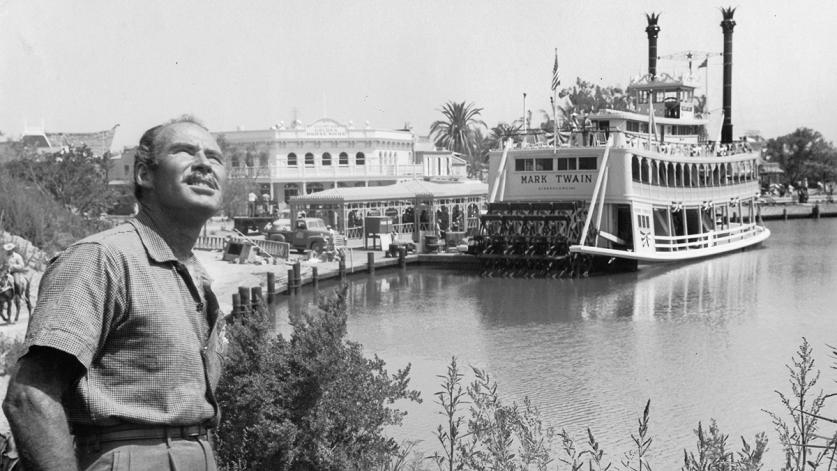
He famously sourced exotic specimens from local estates and even freeway construction zones to give the park an established, “always-been-there” feel on opening day in 1955. Today, his legacy survives in the park’s approximately 18,000 trees and 800 species of plants. I’ll have a dedicated post to him coming soon.
BOTANICAL STORYTELLING, LAND BY LAND
The horticulture team uses “thematic landscaping” to transition guests between worlds without them even realizing the shift. To illustrate the thought behind this, let’s take a look at just the original lands open in 1955, which are all distinctly different.
Main Street USA
This land’s aesthetic is strictly Victorian, with characteristics like formality and symmetry.

The flowerbeds here change seasonally to provide pops of color at eye level, while the street trees are carefully pruned to ensure they never obstruct the forced perspective of the upper-story architecture.

Adventureland
To create the illusion of a lush tropical forest, the team utilizes a “layered” approach.

Dense canopies of ficus and bamboo block out the rest of the park, while “extravagant” broad-leafed plants like hibiscus and bird of paradise create help completely encircle you in greenery.

Frontierland
Here, the palette shifts to the rugged American West.

You’ll find tougher, more arid-appropriate foliage like ponderosa pines and manzanitas, some of which are native to Anaheim, which is quite the contrast to most of the park. And then on Tom Sawyer Island, you’ll also find softer plants that are safer for running children (and provide parents with much needed shade!).

Fantasyland
The greenery here is designed to look like a storybook illustration brought to life. The palette is romantic and softly colored in most areas, featuring pastel flowers, weeping willows, and shrubs cut into swirling shapes.

The most unique landscaping area surrounds the Matterhorn, with and groundcovers that resemble alpine flora you’d find high in the mountains.

Tomorrowland
In 1998, Tomorrowland underwent a “vision of the future” redesign that introduced a unique concept: edible landscaping.

Many of the plants in Tomorrowland (from kale and artichokes to citrus trees) are meant to be sustainable and functional, representing a future where humanity lives in harmony with its food sources.

THE MILLION FLOWER MISSION
Disneyland is famous for its seasonal color changes, but the scale of these rotations is staggering. The park replaces approximately one million annuals every year. These changes happen almost exclusively under the cover of darkness. Between the hours of 12:00 AM and 6:00 AM, crews swap out thousands of flats of flowers so that guests returning the next morning find a completely refreshed landscape.
The most iconic example is the Mickey Mouse Floral at the main entrance. This single display utilizes between 3,000 and 4,500 plants per rotation and is replanted up to nine times a year to reflect the seasons.

USING PLANTS TO CREATE SCALE
Disneyland utilizes plants not just for decor, but also to help create scale, both large and small.
It’s A Small World
This attraction features a display of over 30 animal topiaries. They portray massive animals (giraffes, elephants, and whales), and their positioning above the boats riders take helps give the impression they are significantly larger than they actually are.

Storybook Land Canal Boats
On the other end of the spectrum, the canal boats need you to believe you’ve shrunk to fit into a storybook. Here, the team utilizes stunting techniques and specific species of dwarf conifers and pomegranate trees to ensure the flora remains in scale with the miniature castles of Arendelle and Agrabah.

HORTICULTURE TRIVIA
And finally, here are a few fun facts I learned as I did research for this post.
- The flowers surrounding Walt and Mickey always stay at a low height, so they don’t interfere with castle photo ops.
- Similarly, the trees surrounding the castle will never grow taller than the roof. That way, the castle appears to tower over the park despite its height of only 77 feet.
- There is a flower called the “Disneyland Rose”, a specific breed that’s a mix of orange and pink.
- This one seems more like an urban legend because I couldn’t find any real proof of it. But many of the trees within the Jungle Cruise were planted “upside down”. I’m still not totally sure what that means, haha.
- Not a myth: the Jungle Cruise area is a self-sustaining microclimate, often staying several degrees cooler than the rest of the park.
I know nobody goes to Disneyland to look at trees and flowers. But the horticulture teams that take care of the plant life play such a critical role in the park experience. If the spaces weren’t so beautiful and thoughtfully designed, you would absolutely notice the difference. So during your next visit, take 30 seconds – even if you’re just standing in line. Look at every plant around you and appreciate the thought someone put into placing it there. Each one contributes to the magic.
I’ve always loved the horticultural aspects of all the Disney parks. So much thought has obviously gone into every single space. In Disneyland Anaheim, the plantings near the Zocolo, along with the architecture, are my particular favourites. They remind me so much of parts of the Southwest, in particular New Mexico, places I absolutely love.
I know the exact garden you are talking about – and I totally agree. The succulents are so beautiful!